 The torso murders revealed Eliot Ness’ talents — and exposed his flaws.
Read the story at Cleveland Magazine.
 Former Ohio House Speaker Armond Budish seems destined to crush his opponents and become the next Cuyahoga County executive. He’s chased the job for more than a year. He won the money primary and insider’s game long before your chance to vote. How do you feel about that?

Judge Harry Jacob III promised to bring greater integrity to Bedford Municipal Court. He seemed like the guy next door — family man, soccer coach, gentleman. Now he’s accused of frequenting a brothel, accepting sex as a bribe and promoting prostitution — a charge often used against pimps. What really happened when he met the Studio 54 Girls?

markwinegardner.com
Is there such a thing as Rust Belt literature? Could it help define a regional identity and offer a way out of the Midwestern writer’s trap? I asked Mark Winegardner, author of the epic Cleveland novel Crooked River Burning.
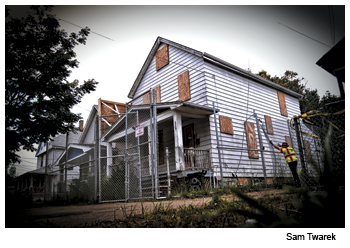 For a century, the house sheltered working-class families, hosted holiday parties and held fond memories. Then Ariel Castro made it into a secret prison.


The public housing security guard was convicted of killing 76-year-old Dorothy Brown in her apartment. But after serving 11 years of a life sentence, Ayers was set free based on questions about the police investigation. Then, he put the cops on trial and won a $13.2 million verdict.
 When Yvonne Pointer’s daughter, Gloria,
was murdered in 1984, the mother of three dedicated her life to service and activism. Her daughter’s case went unsolved for 29 years — until this May, when a suspect was charged in the slaying. Now, Pointer faces a new challenge: She must find herself.
I wrote this essay on Harvey Pekar, Cleveland’s great underground comics writer, for Rust Belt Chic: The Cleveland Anthology. You can buy the book online here or at any indie bookstore in town. It includes most of the great Cleveland writers I know.
 Harvey Pekar — the grouch, the pessimist, the quitter — wrote about the Cleveland that really was, not the Cleveland we aspire to be. He debuted his underground comic book American Splendor in 1976, seven years after the Cuyahoga River last caught fire and two years before the city’s default. With American Splendor’s tagline, “From off the streets of Cleveland comes…” Pekar used the city’s “mistake on the lake” reputation to launch his literary persona: the heroic anti-hero.
Cleveland animated Harvey Pekar’s work. Home was his recurring subject, his nagging muse, his alter ego. More than any other Cleveland writer, Pekar personified his hometown. “The city started to decline,” he wrote in his posthumous book Harvey Pekar’s Cleveland. “So did my luck.”
A frustrated athlete, college dropout, moody lover and self-doubting artist, Pekar had a self-esteem problem before Cleveland’s raged. His memoir The Quitter recounted his bitterness at his own mediocrity, his unwillingness to stick with a sport he was merely good at. His short temper sabotaged him until he lowered his expectations and accepted the stability of his famously unfamous VA file clerk job. Only then, in his late 30s, did he find his artistic medium and creative breakthrough.
Inspired by his friend Robert Crumb and other creators of underground comics, he made the unlikely transition from jazz critic to comic book writer. His aversion to superhero comics compelled him to explore their opposite. He decided that his life, or anyone’s, could be art if observed and rendered with insight, wit and an ear for dialogue.
“Ordinary life is pretty complex stuff,” he declared. That theme resonated more deeply because it came from the streets and porches of Cleveland, not our endlessly celebrated capitals of creative class culture.
Pekar died in 2010. Two years later, writers, thinkers, and artists in the Great Lakes states are embracing the remnants of our cities’ boomtown glories, finding meaning in the struggle to respond to our economic decline, and creating something new from what’s left. This “Rust Belt chic” movement is an attempt to finally prove that the factory coast actually has a distinct culture.
A lot of people don’t believe that, including people from the Rust Belt. They think we’re the norm, the people with no regional culture, the people who sound like the people on TV. We’re flyover country. The place talented people used to be from. The place with no “there” there.
Decades ago, Pekar’s work was already refuting the idea of the Rust Belt as a non-culture. Like today’s Rust Belt artists, he was fascinated by the city’s ethnic heritage, fluent in the history recorded in their grand architecture, obsessed with a sense of loss and ruin. But there’s one very important difference between him and his enthusiastic Rust Belt chic successors: Pekar’s view of Cleveland and the Rust Belt was almost entirely devoid of optimism. In fact, Pekar was a gloomy man. I discovered that right away when I interviewed him and his wife, Joyce Brabner, in the fall of 2003. American Splendor, the biopic about Pekar’s life and comics career, had just made Pekar the everyman hero of indie cinema, but the experience had failed to dent his permanent frown.
“This was kind of an exceptional time for me, a diverting time,” he told me, his huge, dark eyebrows in full weedy bloom. He was “kinda depressed” it was ending, since he had to hustle for writing jobs again. Maybe the movie would help, he allowed. “Then I’ll be happy,” he said — and caught himself. “At least as happy as I get, which is not too happy.”
I respected that. Pekar’s gloom gave him an artist’s vision of Cleveland, like a painter going through a lifelong gray period. His realist’s eye caught something about the town by focusing on his monotonous job, his favorite cheap restaurants, his bohemian’s taste for jazz and klezmer.
Over breakfast in a diner, cartoon Harvey chatted about the yuppies moving into Ohio City, driving up rents. Telling a story about his family, he looked up at a two-story double house and told his readers how Cleveland was once filled with big families who’d share a home – two sisters, for instance, and their husbands and kids, one on each floor. His collage of West Side Market images showed the characters, the crowds, and the hucksterism of the vendors.
“Ever see anything prettier?” one asked, holding a handful of cherries out to the reader.
Historians and sociologists must envy Pekar’s penetrating observations of how regular people lived and experienced Cleveland’s massive social changes over the last 70 years, as well as his understanding of how neighborhoods developed reputations and captured imaginations. The best parts of Harvey Pekar’s Cleveland, for instance, follow him on strolls through neighborhoods he’s known: Cleveland’s Southeast Side in his youth, the lost ‘60s bohemia at Euclid and East 105th, Coventry’s evolution from the ‘70s to today.
His social commentary is especially strong when it turns to Cleveland’s race relations. Though bullied as a kid for being one of the few whites left in his neighborhood, he remained curious about black experience all his life, rejecting cynical withdrawal but also avoiding easy idealism and feel-good buzzwords. Both sides of the divide have done each other harm, he insisted, but we can and ought to do better. One scene in Harvey Pekar’s Cleveland seems especially prescient: He walks his beloved Coventry Road, angrily defending multiracial Cleveland Heights’ reputation from the fears of some whites. Pekar wrote the scene about a year before the 2011 “flash mob” controversy, when the city imposed a strict youth curfew on Coventry and Lee roads to deter gatherings of several hundred black teens. His loyalty to Cleveland Heights reads even more powerfully and poignantly now.
In an American Splendor comic from the ‘80s, Pekar tags along on a sightseeing tour for a visiting writer that included the steel mills and the Orthodox church where The Deer Hunter was filmed. But the grandeur of St. Theodosius did not inspire him to swooning hopes of civic rebirth.
“Boy, Cleveland really seems like it’s dying,” he lamented.
He never wavered from that judgment. After Mayor George Voinovich’s 1980s “Comeback City” vision realigned the city’s politics and social debate, Pekar became the literary voice of the anti-boosters. His pessimism led him to mistrust the comeback stories Cleveland tells itself. He refused to visit the Rock and Roll Hall of Fame and mocked the painted-face Dawg Pound crowd that celebrated the Cleveland Browns’ return.
When I met him, Jane Campbell, then mayor, had just dissed him. He’d written a New York Times op-ed cartoon in response to the August 2003 electrical blackout, which had started in Northeast Ohio and spread across several states.
“Once again, they’re laughing at my hometown,” it began. The op-ed lamented Cleveland’s Rust Belt plight, the loss of people and industrial jobs. “An air of depression pervades the city,” Pekar wrote.
He warned that America ignored the troubles of cities like Cleveland and Detroit at its own peril. But his gloom had left the mayor peeved.
“There’s a lot more going on than Harvey Pekar seems to know,” Campbell sniped.
“Harvey’s been attacked for that for years,” Brabner told me. She recalled his cranky late-night jousts on Late Night with David Letterman.
“Harvey, how are things in Cleveland?” Letterman asked him once.
“What aspect of Cleveland life are you particularly interested in, Dave?” Pekar asked, his voice lilting with sarcasm. “The climate? The unemployment situation, perhaps?”
Afterward, civic boosters asked Pekar why he hadn’t raved about the new Jacobs Field.
“There are people who like me to talk about Cleveland the way it is and be honest,” he
explained.
Exactly. Pekar had to be relentlessly unsentimental to achieve his art: Seeing Cleveland’s essence in everyday life.
Pekar would likely have scoffed at any enthusiastic use of the phrase “Rust Belt chic.” He was the opposite of chic. The term could only have applied to him in the most ironic way.
In fact, his wife, Joyce Brabner, likely coined the phrase in a 1995 interview. She wasn’t talking about local pride, but about New Yorkers’ condescending tendency to reduce Midwestern culture to kitschy stereotype. “Anorexic vampires” and “MTV people” were “knocking on our door,” she lamented, “asking to get pictures of Harvey emptying the garbage, asking if they can shoot footage of us going bowling. But we don’t go bowling, we go to the library.”
Yet eight years later, the American Splendor filmmakers showed that out-of-towners could understand Pekar and the Rust Belt in a deeper way. They took Pekar’s wintry vision and let just a little sunlight in, distilling his marriage to Brabner into a misfits’ love story and casting a lover’s eye on the misfit city. Shooting in Cleveland and Lakewood, the filmmakers discovered the town’s character in little bakeries and diners and brick apartment buildings, spots unchanged since at least the 1970s. Perhaps the most poignant, haunting scene in the film comes when actor Paul Giamatti recites Pekar’s “Who Is Harvey Pekar?” monologue, an existential reflection prompted by finding other Harvey Pekars in the phone book. During part of the monologue, Giamatti paces in front of an aging brick warehouse or factory as snow falls. The post-industrial emptiness of the backdrop reflects his yearning for meaning. Like Pekar’s comics, the movie made Cleveland’s distinctiveness fascinating and metaphoric long before the current Rust Belt buzz.
I doubt Pekar would ever have entertained more than a faint hope that embracing Rust Belt culture would lead to an economic revival. He’d seen too much to put faith in that. His work stands as a warning to the next generation of creative Rust Belt residents: an artistic embrace of one’s home can lose its artistry and honesty if it slides into sunny cheerleading.
Instead of accepting optimism as a civic duty, Pekar celebrated Cleveland’s distinctiveness while confronting its problems. He rejected boosterism but embraced stubborn loyalty.
Gary Snyder’s line about the Clevelandness of ‘60s poet d.a.levy describes Pekar too: “His hometown, Cleveland, that he wouldn’t move from. Like the Sioux warriors who tied themselves to a spear and stuck it in the ground, never to retreat.”
The end of the story is written in the last pages of Harvey Pekar’s Cleveland: the writer settling into retirement in a place where triumphant moments are fleeting and happy endings elusive — in other words: home.
==
Portions of this essay first appeared in Cleveland Magazine.
Art from smithmag.net/pekarproject.

